Monday, March 15, 2010

Practices of Looking - The Value of Images

Images are awarded different kinds of values; monetary, social and political. In the art market however, an images value is determined by economic and cultural factors. An images worth can not always be determined by looking at the image itself, but by the information we bring to it; such as the artist, authenticity or uniqueness.

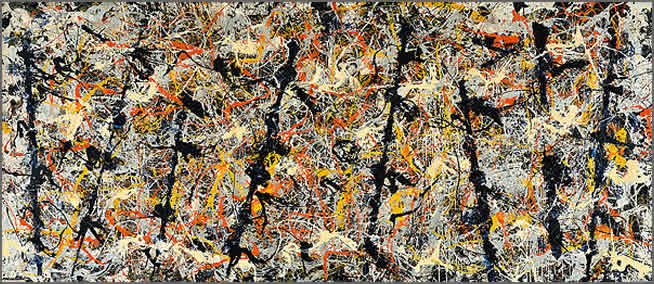
Jackson Pollock, Blue Poles, 1952
Blue Poles by Jackson Pollock is a good example of this, as you can not tell by looking at it, but it was bought by the Whitlam government for the National Gallery of Australia for $1.3 million., at the time this was the most money ever paid for a modern painting. Paying this amount of money for a modern painting created a lot of controversy with the public, ironically this controversy promoted for a tour of the painting and it's fame rose. The painting is now estimated to be worth over $100 million.

Technique is an important factor in determining worth. If a technique is considered to be unique it can add value to the image. Work by artists such as Monet, Van Gogh and Picasso are among the most valuable paintings in the world as they are considered masters of their painting styles and were the first major artists of that style at the time.
Authenticity is important in value as well. Works by some art masters can be hard to prove as authentic. So proof of this is highly regarded.
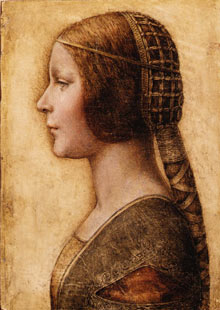
The Head of a young Girl, a painting attributed to Leonardo Da Vinci
There was a recent story in the art world about a painting that was bought for about $20,000 by a private art collecter that was thought to be by a German painter. After it was bought art historians studied the painting and now believe it to be that of Leonardo Da Vinci, making it worth tens of millions of dollars.
The artwork itself hasn't changed, but now that the artist has changed it has become much more valuable, which shows that the art itself does not really have much value on it's own; but the information behind it does.
Work by Leonardo Da Vinci is valued to be the highest in the world, partly because of his greatness and intelligence, but also party because of the amount of work produced by Da Vinci; he was so busy during his life that he rarely finished a painting, so painting such as the Mona Lisa are worth incredible amounts as they are his only finished works.

Art can also be valued by its reproduction value. Paintings can be copied at made into merchandise which is then sold and made profit out of.

Cultural value can adhere to images that portray an important event in a countries history. Photographs of war or other events can be highly valued as they portray what is going on in the world. Images these days can be transmitted to a large audience quickly and easily, the images may not contain value in the art or economic market, but on a cultural level as it makes a statement of human will

In conclusion, images can have value on a number of different levels, whether it be monetary, economical, political or cultural.


Blue Poles by Jackson Pollock - http://abstract-art.com/abstraction/l2_grnfthrs_fldr/g001_pllck1_blue_poles.html


Profile Portrait believed to be by Leonardo Da Vinci - http://www.guardian.co.uk/artanddesign/2009/oct/13/leonardo-da-vinci-painting-discovered

Friday, February 19, 2010

Assignment #1 - Ethical Photojournalism Article

From:
Focal Encyclopedia of Photography
Fourth Edition
Michael R. Peres, editor
Focal Press, London, 2007


Article:
Ethical Photojournalism: Its Authenticity and Impact
John Kaplan


The main issue raised in the text is the authenticity of photojournalism. John Kaplan explains that in order for a photograph to be truthful, there are different measures which must be considered in order to give an accurate depiction of events. He explains that authenticity is very important in photojournalism, and that it should be believable. In order to do this, all photojournalists have to be very careful not to lose their credibility as this can damage how everyone perceives photojournalism. John Kaplan explains that it is a photojournalists responsibility to accurately display the events that occurred.
 Manipulating photos is the worst offender in damaging the credibility of photojournalism. However even not including photos, bias towards a topic and even lifting a camera can all contribute to the inaccuracy of events.

This photo is of some Palestinian boys who were shot after throwing large concrete bricks in protest around the West Bank city of Nablus. This photo, however, was not included in the article. Which stated:

"Israeli soldiers have shot dead three Palestinians, including a 15-year-old boy, who were throwing stones in protests around the West Bank city of Nablus early on Saturday local time, Palestinian medics and witnesses said."

By just reading the article, it seems as if some poor kids were needlessly shot for throwing a couple of rocks, however in reality they were doing something much more dangerous, and would have likely killed people if they were not stopped.
Not including this photo in the article means that readers do not get an accurate insight to what really happened, and completely changes the side of the story.


Photographer: Unknown
Photo taken from: http://www.honestreporting.com/a/photoBias.asp - This is a compelling article which gives some brief insight to bias and photojournalism. It is a good summary and makes a few interesting  points. If you are interested I highly suggest reading it, as it gives some good examples of authenticity (or the lack of) in photojournalism.

Ethics - Aboriginal children postcards

postcard2
Response to Article:

Naked Aboriginal kids on postcards: the line between art and exploitation?

I just read the article Silvia posted up, and to be honest, it made me sick. Not because they are "exploiting" aboriginal children by photographing them for postcards, but that our Western society seems to view this as child pornography. This postcards are simply showing the innocence and free spirit of children in their natural surroundings, and no matter what race they are, this should be seen as beautiful. By saying these photographs are pornographic is just teaching our children that the naked body is disturbing and disgusting, which to me is a much worse moral dilemma.

The article also mentions that the photographers gained permission from the parents in these photos, but what the article is trying to say is that these parents are not able to make correct judgement and their permission is not enough. Is it just me... or does it seem like that is a tiny bit racist?
Saying that the Aboriginal parents permission is not enough (due to the fact they are getting royalties) is just saying that they cannot make educated decisions by themselves, which is unfair and unjust, even if the reason is to protect them.

As for the exploitation of Aboriginal people goes, as long as the photographer receives permission for the parent or guardian, I hardly see it as exploitation. If it was a couple of white children naked on a beach, the child pornography would most definitely still be in debate, but I doubt anyone would say it is exploitation.

Pretty soon we will not be able to take photos of our own children playing outside or in the bathtub, without being prosecuted for child pornography.


Photograph by: Peter Lik
Photograph and Article taken from: http://www.crikey.com.au/2010/02/18/naked-aboriginal-kids-on-postcards-the-line-between-art-and-exploitation/