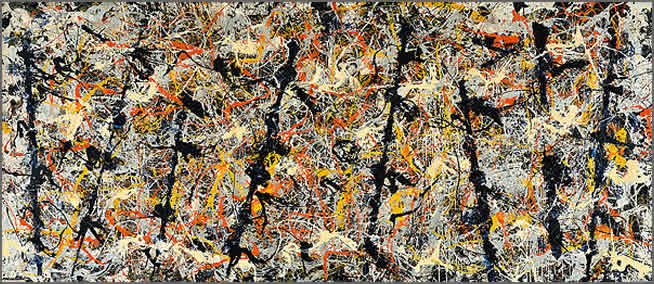
Blue Poles by Jackson Pollock is a good example of this, as you can not tell by looking at it, but it was bought by the Whitlam government for the National Gallery of Australia for $1.3 million., at the time this was the most money ever paid for a modern painting. Paying this amount of money for a modern painting created a lot of controversy with the public, ironically this controversy promoted for a tour of the painting and it's fame rose. The painting is now estimated to be worth over $100 million.
Technique is an important factor in determining worth. If a technique is considered to be unique it can add value to the image. Work by artists such as Monet, Van Gogh and Picasso are among the most valuable paintings in the world as they are considered masters of their painting styles and were the first major artists of that style at the time.
Authenticity is important in value as well. Works by some art masters can be hard to prove as authentic. So proof of this is highly regarded.
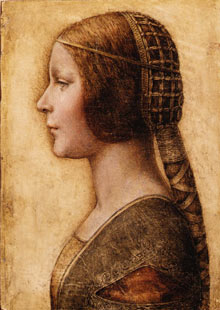
There was a recent story in the art world about a painting that was bought for about $20,000 by a private art collecter that was thought to be by a German painter. After it was bought art historians studied the painting and now believe it to be that of Leonardo Da Vinci, making it worth tens of millions of dollars.
The artwork itself hasn't changed, but now that the artist has changed it has become much more valuable, which shows that the art itself does not really have much value on it's own; but the information behind it does.
Work by Leonardo Da Vinci is valued to be the highest in the world, partly because of his greatness and intelligence, but also party because of the amount of work produced by Da Vinci; he was so busy during his life that he rarely finished a painting, so painting such as the Mona Lisa are worth incredible amounts as they are his only finished works.
Art can also be valued by its reproduction value. Paintings can be copied at made into merchandise which is then sold and made profit out of.
Cultural value can adhere to images that portray an important event in a countries history. Photographs of war or other events can be highly valued as they portray what is going on in the world. Images these days can be transmitted to a large audience quickly and easily, the images may not contain value in the art or economic market, but on a cultural level as it makes a statement of human will
In conclusion, images can have value on a number of different levels, whether it be monetary, economical, political or cultural.
Blue Poles by Jackson Pollock - http://abstract-art.com/abstraction/l2_grnfthrs_fldr/g001_pllck1_blue_poles.html
Profile Portrait believed to be by Leonardo Da Vinci - http://www.guardian.co.uk/artanddesign/2009/oct/13/leonardo-da-vinci-painting-discovered
No comments:
Post a Comment